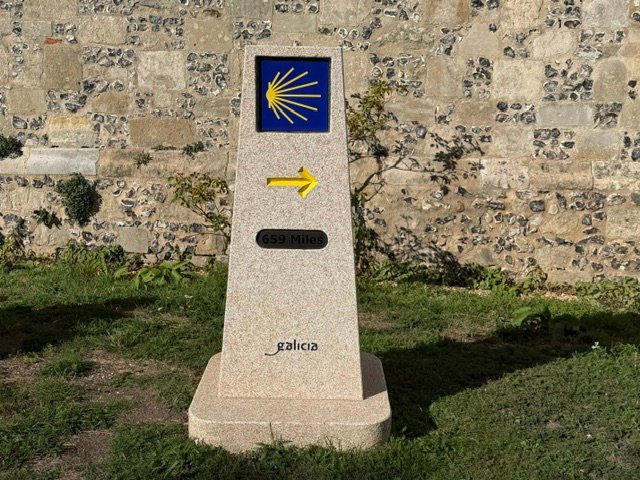
One day I’d like to walk one of the long distance Caminos; perhaps the Camino Francés or the Camino Portugués to Santiago de Compostela in Spain.
However, for this challenge, I decided to start with an English Camino – the St James’ Way – from Reading to Southampton. It’s 68.5 miles, which I split over five Saturdays in early autumn. As I live relatively close to Reading it was easy to complete the walk using trains and buses.
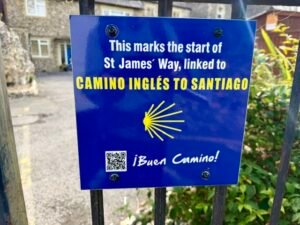
My journey started at Reading Museum, where I registered my intent to walk the Camino, bought a guidebook to the route and a Pilgrim Passport (to collect stamps in). These cost a total of £18, and were well worth the money; both enhanced my enjoyment of the route. I also downloaded the route from OS Maps as the guidebook only includes written instructions, no maps.
Stage 1: Reading to Mortimer – 11.5 miles
I’m already familiar with Reading so I didn’t spend any time sightseeing at the start. Instead, I found my way to the River Kennet and started walking. Despite the presence of graffiti and litter for the first mile or so I was lucky to see lots of different birds in a short space – jays, a woodpecker and a kingfisher.
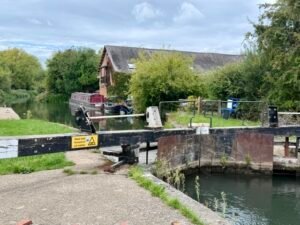
After leaving Reading the next four miles were beside the Kennet & Avon canal, so navigation was straightforward. At one point I stopped to let a jogger pass and he wished me “Buen Camino”. It made me smile and, unbeknown to me, was the only one of my entire walk!
After leaving the canal I stopped at the Fox and Hounds to get my first stamp in my pilgrim passport since leaving Reading. I bought a coffee, and was tempted by the food, but already had lunch with me. Instead I pressed on, braving a field of cows and a bull, before arriving at Sulhamstead Abbots church.
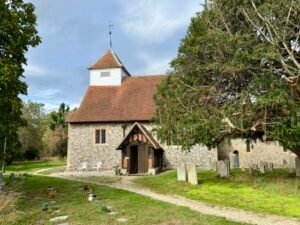
Along with many of the pilgrims who walk a Camino, I’m not religious – I just enjoy walking. However, I do appreciate the history and architecture of churches so I made an effort to visit as many as I could along the route. As I only bought the guidebook on the morning of my first walk I hadn’t realised that some churches needed to be contacted in advance so they could open up.
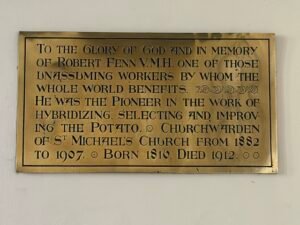
St Mary’s Church was one of these as it usually requires a day’s notice to open. However, I had luckily coincided my walk with a fundraising Ride & Stride event, so the church was open. My attention was drawn to a plaque in the church that celebrated a local man, Robert Fenn, who improved and hybridised the potato. I’m not sure why this particular claim to fame appealed to me so much!
The guidebook mentioned crossing a ford after leaving Sulhamstead. This always makes me slightly nervous as I expect a raging torrent, but fortunately there was very little water – and a bridge to bypass it.
From Burghfield Common I had a pleasant walk through woodland, which made a complete change from the earlier canal side path. I reached Mortimer and found a passport stamp available at St John the Evangelist Church – this is another church that is usually closed, but was open for Ride & Stride. From Mortimer I took the bus back to Reading.
Stage 2: Mortimer to Worting – 14 miles
Whilst I loved the St James’ Way overall, day two was probably my least favourite stretch. Too much fast traffic along narrow roads and quite a lot of construction, from solar farms to housing estates.
The day started with a 1.5 hour walk, bus and train journey back to Mortimer, followed by easy walking along the sides of fields, through woodland and along roads. I passed the county boundary early on, and was strangely excited to be leaving Berkshire and walking into Hampshire.
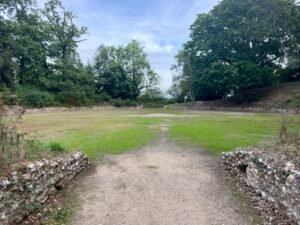
I stopped to explore the Silchester amphitheatre and popped into St Mary the Virgin Church for a stamp, but skipped the suggested route through the Roman ruins as I’ve walked it before.
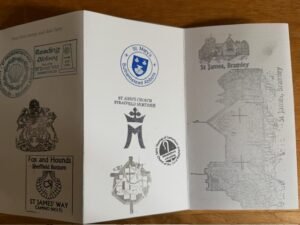
At the next church, St James’s in Bramley, I used the super-sized stamp — it practically filled a whole page! I also stopped at The Barn for a second breakfast of yoghurt, pancakes and banana. It was delicious, but possibly a bit too filling, as I was still full when I reached Little London, where I’d originally planned to eat at The Plough Inn.
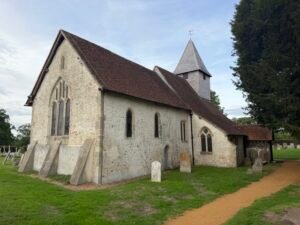
Instead I carried on to Monk Sherborne where I detoured to All Saints Church, hoping to find the unmarked grave of George Austen, Jane Austen’s brother. Unfortunately, nobody knows exactly where he’s buried, so that was a bit of a non-starter.
The walk then continued beside a golf course, where I was relieved to find the overgrown path had been cut back. Things got less pleasant at the A339, which was horrible to cross. I had to wait several minutes before there was a gap in the cars and lorries streaming past.
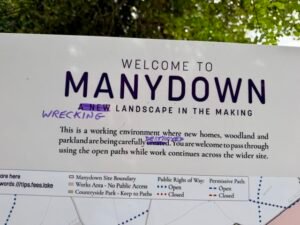
Onwards to Worting, where I discovered that a footpath had been closed and diverted around a new housing development. Judging by the defaced signs the locals aren’t too impressed with the new development. However, I enjoyed the diverted route through woodland and on to St Thomas of Canterbury Church in Worting. The church itself locked, but luckily there was a stamp in the porch.
A late ploughman’s lunch at the Parlour Teabarn, just off the route in Worting, rounded off the day nicely before I caught the bus back to Basingstoke station for the journey home.
Stage 3: Worting to New Alresford – 16 miles
This was a longer walk than the guidebook suggested because I needed it to fit in with public transport options. I therefore stayed in an Airbnb in Basingstoke so that I didn’t need to spend the first couple of hours getting to my walk.
I was out of the door and walking at 8am and hardly saw a soul for the first couple of hours. My first church of the day was in Dummer and then I had a lovely autumnal walk to Preston Candover. Autumnal because the grass was wet and I kept walking into spider webs!
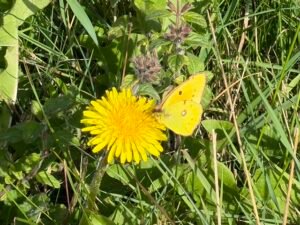
I took a walk variant near Preston Candover and somehow managed to get a little lost. My book suggested I’d find a 20 seat bench with great views, instead I wandered around a bike track in a wood. The upside was that I found a field alive with clouded yellow butterflies! Fortunately, I wasn’t too lost as I still made it to the community shop at Preston Candover, where I stopped for coffee and a shortbread biscuit.
I visited the historic St Mary the Virgin church on my way out of Preston Candover. Managed by the Churches Conservation Trust, only the graveyard and 13th Century chancel remains but it was atmospheric and interesting to visit.
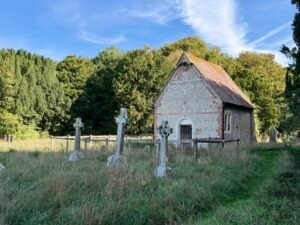
A little later I came across a family who were also completing the walk, albeit in short stages. They were my first pilgrims of the walk; it was lovely to have a quick chat with them! I then continued across ploughed fields and farmland to Upper Wield where this stage traditionally ends. However, after a short rest and a bottle of chocolate milkshake I set off towards New Alresford along the Drovers Way.
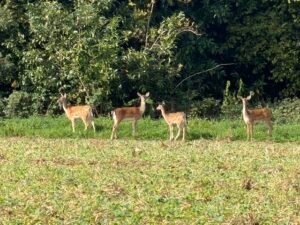
I followed this long straight path for what felt like miles, only stopping to watch some deer. Eventually I reached the outskirts of New Alresford, and saw my first watercress bed. The town is famous for its watercress farming, hosting an annual festival dedicated to it. I ate a late lunch which included a garlicky watercress pesto. Not bad!
From New Alresford I caught the bus to Winchester, and then back home via the train.
Stage 4: New Alresford to Winchester – 11 miles
Although I walked the rest of the trail alone, my partner accompanied me on this stretch. As there were railway works and a replacement bus service we drove to Winchester and then took the bus back to my previous stopping point in New Alresford.
My first task was a visit to the Watercress Line steam trains to pick up a novel stamp for my passport – a postage seal. A train was about to leave and the platform was heaving with visitors; I was tempted to take a ride but it would have messed with my walking schedule.
Instead we left town, walking past lots of watercress beds towards Ovington. The walk took us beside the crystal clear River Itchen and I concur with the guidebook that it is one of the most picturesque sections of the walk.
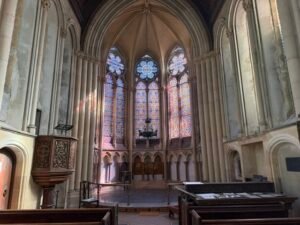
In Itchen Stoke we detoured slightly to visit St Mary’s Church. It’s famous for its labyrinth, which is modelled on the one in Chartres Cathedral – albeit much smaller!
We walked on through marshland, that was bone dry on our visit but looked like it might cause issues during wetter years. After a while we reached Avington Park Golf Club, where we stopped for a cup of coffee. We then got caught up in a large group of ladies, who were also walking the Camino.
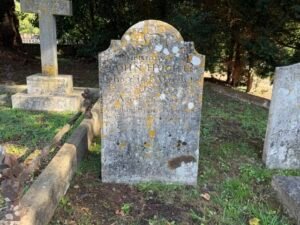
This meant there was a bit of a queue to use the very welcome toilet facilities at the Church of St John the Baptist in Itchen Abbas. Outside we searched for John Hughes, who is buried in the church graveyard. He was the last person to be hanged for horse stealing in England.
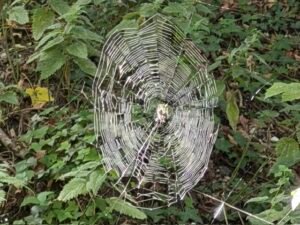
Our afternoon walk took us under the M3 and then onto Hyde. The most exciting part was spotting some enormous spider webs sparkling in the sun. I’m rather glad we didn’t see the spider though, as it would easily have been the size of my fist!
In Hyde we stopped at St Bartholomew’s Church to find one of the Camino Milestones. From this point it was exactly 100 miles by foot (let’s ignore the sea!) to Santiago de Compostela Cathedral.
The rest of the day’s walk took us through the suburbs into Winchester. A relatively short walk overall, but full of variety and autumn sunshine.
Stage 5: Winchester to Southampton – 16 miles
This was my final day on the Camino and it was a long one.
I started relatively late due to train delays so I was a little disappointed that I didn’t get a chance to look around Winchester Cathedral. However, I still managed to get a stamp for my passport.
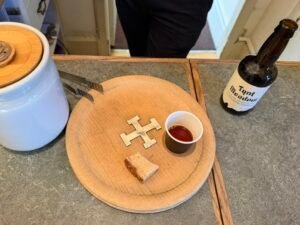
I did make time for the wayfarer’s dole at the Hospital of the Cross on the outskirts of Winchester. This 900 year old tradition provides pilgrims with a portion of bread and a cup of beer. I’m not much of a drinker, particularly in the morning, but it was lovely to stop and chat with the man who served it. Highly recommend – just pop into the Porter’s Lodge and ask for it.
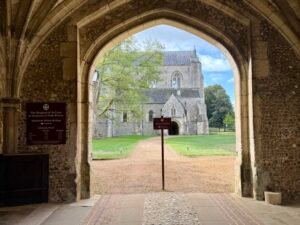
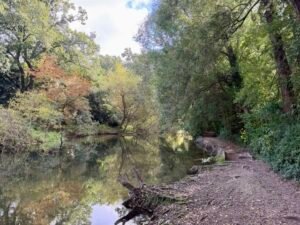
My walk continued, following the Itchen Way, beside the river into Shawford. It was mostly idyllic aside from an encounter with a black Labrador who had been splashing around in the river and then ran towards me (twice) barking and baring its teeth. I love dogs generally but it scared me and the owner couldn’t have cared less.
After Shawford I had a decision to make. The guidebook mentions a section where the river always floods, and the path is only passable for a few months each year. I decided to take the detour, just in case, although I later discovered there was no need to do this.
I detoured again into Eastleigh for lunch. The Coffee Cabin is about 10 minutes off route but absolutely worth the extra steps.
The feel of the route changed abruptly after lunch. I’d really enjoyed the morning walk but the route from Eastleigh felt rather unloved. I barely saw another walker and the trudge around the edge of Eastleigh Sewage Works seemed to go on forever. I’d hoped to enjoy the subsequent walk beside Itchen Valley Nature Reserve but for some reason it felt ominous, and my imagination worked overtime.
I eventually popped out at Mans Bridge, and walked through the large riverside park. This was full of people enjoying their Saturday afternoon – children on scooters, young lads fishing, joggers and strollers. I felt a lot more comfortable.
At the main road I realised I was truly in Southampton’s suburbs. I passed St Mary’s Stadium, walked through housing estates and community centres. I missed the picturesque river scenes of my morning walk but I was excited to near the finish.
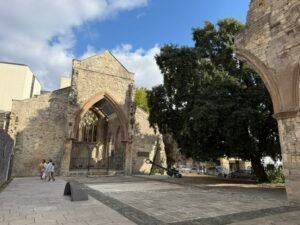
En route I visited the remains of Holyrood Church, which was bombed in World War II. Only the tower and chancel remain. From the church it was a short distance to the end of my walk at God’s House Tower.
It was with a mixture of elation and sadness at finishing the walk that I walked up to the counter and asked for my final stamp. I also claimed my certificate, for completing the Camino. It’s a long time since I’ve received a certificate for anything!
Did I enjoy the Camino?
Absolutely. I was blessed with excellent weather, and I enjoyed the route, which was flat, well maintained and signposted. The only negatives from my perspective were a couple of traffic hotspots, and the final walk into Southampton. That said, I have never walked another Camino so have nothing to compare it to. It was very quiet, and pilgrims who have walked the other more famous routes would probably miss the sociability of these trails.
Challenge completed
Challenge completed. Pop over to read the full list of my 60 things to do before I’m 60.